Health
Quitting Smoking, Standing Practice, and More: (II) Standing Practice
This week, during a traditional Chinese medicine lecture organized by the company, a colleague asked about various matters related to standing practice. Since Professor has recently been studying standing practice, he happened to give a rough answer. As I have some free time today, I have organized it properly for your reference.
On this page
Epigraph: The day I began writing this is the anniversary of the “July Seventh Incident.” In remembrance of our compatriots, our generation too should strengthen itself and never allow China to sink again.
Chinese martial arts have a long and deep history. Speaking only of internal boxing methods, there is a saying about four great famous styles: “Shaolin boxing,” “Xingyi boxing,” “Baguazhang,” and “Taijiquan.” Besides these four great styles, all kinds of smaller folk boxing systems have also emerged endlessly, such as Tongbei boxing, Mizong boxing, Wing Chun, and Pigua boxing. In the old days, all had famous masters passing them down.
Unfortunately, over the past hundred-plus years, the land of China has suffered continuous warfare, compounded by all kinds of campaigns to discard the old and usher in the new, making the inheritance of national martial arts truly difficult. If one wants an intuitive sense of how difficult this inheritance has been, one can first learn how difficult it was in traditional society for clan bloodlines to be passed on.
In 2012, Mr. Chen Xi of Fudan University’s Institute of Historical Geography published a paper in Southern Population. Across more than two hundred years of the Ming and Qing dynasties, only 13.61% of people, after surviving competition for existence, were able to have descendants of their own.
 Open larger image: Southern Population - Chen Xi study
Against such a cruel historical background of intergenerational competition, the Chinese people’s passion for martial valor still preserved the inheritance of national martial arts to a certain extent. However, in martial schools throughout history, lineage heads have always made distinctions between inner-door and outer-door transmission of skills (labels such as “indoor disciple” are also embodiments of various bad customs), and from time to time there has been the worry that “if you teach the apprentice, the master starves.” As a result, the inheritance of sect martial arts often emphasized only techniques and routines, and rarely devoted effort to cultivating internal power or breathing methods.
Thus, in today’s martial world, we only see a certain Teacher Baoguo being hammered by a young sanda fighter, while it is hard to see masters like Shang Ji anymore. Although that Teacher Baoguo was Shang Ji’s indoor disciple, he did not grasp the true meaning of Xingyi boxing. Both master and disciple have published related books. After reading them, it seems that Teacher Baoguo had not yet entered the gate and only had some rough personal understanding of old master Guo Yunshen’s insights, while senior Shang Ji’s book is clearly more pragmatic. Interested readers may explore and compare them on their own.
This kind of regret in the national-martial-arts circle is truly exposed to the fullest in Liao Fan’s film The Master.
Returning to internal martial arts, today they seem more often reduced to health-preservation exercises practiced by elderly people in parks. Little do people know that internal boxing methods are in fact skills for combat and repelling enemies. In orthodox internal lineages, besides teaching special techniques, masters must also teach disciples where one may “strike” and where one “must not strike” when facing an opponent, so as to avoid recklessly taking lives.
The foundation of internal martial arts is standing practice. Although the sources of internal boxing arts vary in quality, they share a somewhat similar wonder in this practice of standing.
In the process of writing this article, I mainly consulted boxing manuals from various branches of internal Xingyi boxing. The focus is on how to strengthen the body through practicing standing, rather than on the essentials of combat technique.
Anecdotes from the Martial World
Before formally introducing standing practice, let me first tell readers a few martial-world anecdotes as light entertainment.
In 1915, Zhang Boling, president of Nankai School, hired senior internal-martial-arts expert Han Muxia as a martial-arts instructor, dedicated to teaching martial skills to young students. This gave Han Muxia the opportunity to open a martial arts school around Tianjin and take in many disciples.
Among this cohort of students was a young scholar of excellent academic performance who, admiring Han Muxia’s reputation, went to his martial arts school and asked to come study martial arts every night. Han Muxia had a very pleasant conversation with the young man and immediately agreed. From then on, every night the young man came to the school on time to learn martial arts. Among the fundamentals was standing practice.
This young man not only repeatedly placed first in academic examinations, but also advanced extremely well in internal boxing practice, with his kung fu growing very quickly. So much so that Han Muxia’s son, Han Youxia, was repeatedly admonished by his father to learn from this young man.
Through cold and heat, the young man studied Xingyi boxing with his honored teacher Han Muxia and achieved quite a lot. It was not until the autumn of 1917, when the young man crossed east to Japan to study, that they parted.
By 10 years later, this young man had grown into a youth and, using the pen name from his student days in Shanghai, transformed into “Wu Hao” and gradually accomplished great things. Another 4 years later, because of the “Aitang Village Incident,” the name “Wu Hao” became known throughout the land.
Still later, the young man joined the revolutionary cause all the way, and after enduring countless hardships and dangers, finally reached the pinnacle of power.
This young man was Zhou Enlai, courtesy name Xiangyu.
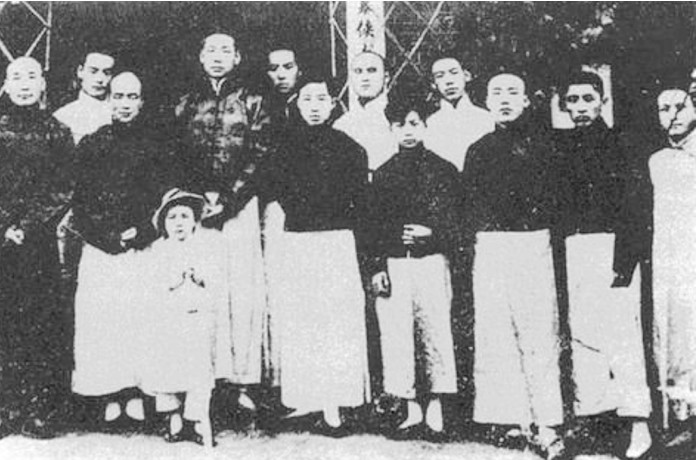 Open larger image: image.png
The second anecdote came by chance while reading history books. Since this year began, besides studying past-life hypnosis and theories of reincarnation, Professor has also been reading Tang history, especially stories from the middle and late Tang.
The assassination of Wu Yuanheng was one of the most sensational unsolved cases of the middle Tang. Historical records state that the true mastermind behind the scenes was very likely the military governor Li Shidao, while the person most suspected of organizing and planning the actual assassination was a monk named Yuanjing. Let us first look at how the history books describe Monk Yuanjing:
Yuanjing was over eighty years old and had once been a general under Shi Siming; he was fierce and valiant beyond compare. After he was captured, a strongman struck his shin with a stone hammer but could not break it. He cursed, “You whelps cannot even break a man’s leg, and you call yourselves strong men!” He then placed his own foot and broke it himself. As he was about to die, he sighed, “You have ruined my affair, and I cannot see Luoyang run with blood!” – New Book of Tang, Biographies, Volume One Hundred Thirty-Eight
In plain terms, Monk Yuanjing was already over eighty and had once served under Shi Siming. He was extremely fierce and brave.
After government troops captured Monk Yuanjing, in order to prevent him from escaping, they had a strongman smash his lower leg with a stone hammer, but the leg did not break. So this villainous monk cursed loudly: “Bastards, you cannot even smash a man’s leg apart. What kind of tough guys are you?”
Then Yuanjing broke his own lower leg. When he was about to die, he viciously lamented: “You ruined my damn business. I cannot make Luoyang run with rivers of blood!”
Although this historical account does not specify Monk Yuanjing’s martial routines, judging from his experience hiding as a monk in Shaolin, what he practiced was most likely Shaolin boxing among the internal styles. Although this villainous monk was malicious, he had indeed practiced internal martial arts properly; otherwise, at over eighty years old, he would not still have had such a hard and fierce physique (bones).
Both of the above anecdotes are stories verifiable in official histories.
By this point, I imagine all of you have a preliminary impression of the benefits that standing practice can bring.
The Change in Stereotypes
At first, Professor knew very little about internal boxing and the foundation of standing practice. The reason was simple: Professor’s field of study was modern medicine, which is based on rigorous scientific research as evidence. For traditional medical theories not supported by experiments or data, he had a rather skeptical attitude. Martial-arts theory, which similarly comes from traditional inheritance, naturally was also affected by stereotypes because it lacks precise theoretical logic and data support.
However, Professor’s connection with internal boxing can also be traced back to the age when he had just started university, basically the same time he came into contact with modern medicine. In those ancient early days, the internet was not as developed as it is now, and online communication on campus mainly took place on the school’s own BBS forum.
One day, among the top ten hot posts, I saw a post in which a lady introduced some interesting stories about her husband’s practice of standing. It had quite a mysterious flavor. From then on, Professor became curious about standing practice and internal boxing methods. Later, in the library, he wanted to borrow related books and unexpectedly really found a book on internal Xingyi boxing.
Looking back now, it was an excellent introductory book. Unfortunately, I have long forgotten its title, which I now rather regret.
The book introduced many fundamentals of internal Xingyi boxing, especially its explanations of standing practice, on which it spent considerable effort. From the functions and benefits of different standing methods to step-by-step introductions to practice points, and even photo demonstrations, it quickly helped Professor understand the ins and outs.
Referring to the book’s explanation, after considering both function and difficulty, Professor chose “hunyuan zhuang” as the object of his attempt. After practicing simply a few times, he felt he had already grasped the essentials, but also found the process of standing rather punishing. Added to the aforementioned stereotypes, he was soon attracted by other things and lost enthusiasm. Thus, although he has been in contact with internal boxing for 20 years, he has made almost no progress. Truly laughable, laughable.
As for the change in stereotypes, that begins with my old father’s surgery two years ago.
Two years ago, on the eve of Shanghai’s lockdown, I happened to receive a call from my mother saying that my old father had been found to have a major health problem and needed surgery as soon as possible. I immediately told my family to arrange a transfer to a top-tier hospital and book surgery, while calling my manager to ask for leave and buying the nearest high-speed train ticket back to my hometown. The timing was frighteningly precise: as soon as I had left, Shanghai officially began its lockdown, so I somehow inexplicably escaped. After returning home, I was still arranged to quarantine in a small dark hotel room for 14 days. Fortunately, my old father’s surgery went smoothly. By the time I was released, he was just about to be discharged. After completing all the hospital’s required visitation procedures and testing certificates, I bought a pile of things and went to see him. At last I was no longer nagged by the old man with “Why hasn’t my son come to see me?”
One month after discharge, the follow-up examination results were all normal.
Two months later, seeing that he was recovering well, I wondered whether there was any exercise that would not be too intense yet could still help strengthen his body. So I demonstrated the key points of hunyuan zhuang to him and asked him to practice for a few days first to see the effect.
People who first practice standing often give up easily because their legs tremble or they cannot grasp the method. To help the old man build confidence, Professor also began practicing standing himself. Gradually, through this process, he extended the time from rookie-level less than 3 minutes to being able to persist for 15–20 minutes per session. But the old man was quite cunning: every day he would stop as soon as he had stood for 5 full minutes. Although his standing time was short, fortunately he persisted every day without fail, and there were indeed some effects.
Whenever I asked the old man whether he felt any bodily changes after standing practice, the feedback was positive. He said directly that his previous constipation had improved a lot. Looking at my own results from standing practice, there seemed to be little. Until one day later, when I rested briefly after standing and noticed some unusual sensations.
This unusual sensation was that, while resting on my side, I felt the rhythm of the taichong channel. It was a rhythmic movement with extremely strong impact force. At first I mistakenly thought it was the rhythm of the heartbeat, but later discovered it was not. This force of the taichong channel seemed to start from beneath the right foot and rush straight toward the top of the head. Its strength was clearly stronger than the rhythm one feels from pressure on blood vessels (such as the pulse), more like shock waves, continuous and unending.
After feeling this impact rhythm more times, I began looking up information and learned that this situation should be related to the chong vessel.
At this point, my view of traditional medicine and martial arts was completely reversed, and I gradually began trying to understand the traditional medical principles that might be hidden within martial techniques. I am still in the process of studying and understanding this knowledge. The later conjectures in this article about the relationship between standing practice and meridians are only Professor’s current personal experience; readers still need to assess them with discernment.
Common Standing Practices in Internal Boxing
The many anecdotes introduced above are mainly meant to arouse everyone’s interest in internal standing practice. Having written this far, it is finally time to enter the main topic.
Generally speaking, the standing practices of internal Xingyi boxing can roughly be divided into “health standing practices” for strengthening the body and “combat standing practices” that emphasize fighting opponents.
Because different lineages have different origins, records of “health standing practices” appear only in a few boxing manuals. Health standing practices can generally be divided into standing, sitting, and lying forms. Their goal is mainly to relax body and mind, with greater emphasis on intention. Common health standing practices include “parallel-step supporting-and-embracing stance,” “parallel-step lifting-and-embracing stance,” “parallel-step lifting-and-inserting stance,” “parallel-step leaning-and-embracing stance,” “parallel-step supporting-and-pressing stance,” “parallel-step pushing-and-lifting stance,” “seated stepping-on-cotton lifting-and-embracing stance,” “seated hooking-and-lifting supporting-and-embracing stance,” “lying supporting-and-pressing stance,” “lying supporting-and-embracing stance,” and various others.
Health standing practices are more suitable for physically weak people or those newly recovered from serious illness. They do not insist on increasing internal force, but seek only for intention to travel through the whole body, warm and bathing-like; for breathing to be soft, even, fine, and long; and for comfort and effectiveness, stopping at what is appropriate. In other words, they place more emphasis on recovery and convalescence.
“Combat standing practices” place somewhat more emphasis on actual fighting and can be divided into static stances and moving stances. Static stances are mainly still while the practitioner stands; moving stances are active.
Xingyi boxing gives first place to the santi stance, also known as the sancai form or ziwu stance. In addition, common “combat standing practices” include songjing stance, hunyuan stance, qiankun stance, taiji stance, fuhu stance (liangyi), fixed-force stance, wuji stance, liuhe stance (chicken-step stance), eagle-form standing practice, bear-form standing practice, and so on.
As one of Xingyi boxing’s most important fundamentals, the santi form is a method composed according to Xingyi boxing principles, the basic requirements and characteristics of the boxing method, and the three-body activity of the human body (head, hands, feet; the three bodies are each divided into three sections, and the boxing principle seems to have something in common with Tongbei boxing). It is also the most basic method for seeking the liuhe hunyuan whole-body force, so Xingyi boxing also has the saying that “all methods come from the santi form.”
For ordinary people with no martial foundation at all, the santi form as a moving-standing practice is obviously a fundamental that is too difficult. After all, ordinary people have not yet fully adjusted their bodily state. Even if they begin with the santi form, the benefits gained are very few. Therefore, Professor more strongly recommends that everyone begin with the static stance “hunyuan zhuang,” then, after gaining a certain foundation, go on to practice the santi form as well as later Xingyi routines and frames.
Hunyuan zhuang benefits the body’s movement of qi and blood. As long as it is practiced properly, long-term persistence can nourish the heart and kidneys well. The rest of this article will also introduce “hunyuan zhuang” as the core. Hunyuan zhuang also has moving-stancing methods, but this article will still focus mainly on static standing.
Preparations Before Standing Practice
Before formally introducing the details of how to practice hunyuan zhuang, all you great heroes still need to confirm some preparatory work in advance.
First is the choice of standing-practice environment. Since the core of hunyuan zhuang is regulating qi and blood, and the body needs to coordinate with breathing during practice, a good standing-practice environment is essential. Professor recommends that readers who have the conditions choose a place full of vitality for practice, and preferably somewhere that allows you to be “feet on solid ground.” In addition, besides ensuring air circulation, the chosen location should also avoid being in a draft. This is to avoid wind evil entering the body when the pores open during standing practice. During practice, clothing should be loose and comfortable, and shoes may be cloth shoes or cotton shoes more suitable for practice.
Second is the choice of standing-practice timing. Generally speaking, the appropriate time for standing practice is early morning or dusk. In summer especially, one should avoid standing at noon, so as not to let excessively hot weather make the body sweat profusely and deplete bodily fluids.
Finally, there is the influence of personal health. Although the hunyuan zhuang introduced in this article can unblock qi and blood, its exercise intensity is still very high. Please ensure your body is healthy and free of problems before practicing. If any readers are newly recovered from serious illness, they may first try quiet sitting or lying forms among the “health standing practices,” and after the body has recovered, then consider whether they can practice hunyuan zhuang. Later, Professor will also write a separate article introducing the method of quiet sitting; readers who need it, please stay tuned.
Last of the last, there is preparation in medical knowledge. If practitioners can learn some knowledge of human anatomy and meridians and acupoints in advance, it will be like adding wings to a tiger during practice.
How to Practice Hunyuan Zhuang and Its Key Points
The specific method for practicing hunyuan zhuang is as follows:
- The practitioner stands naturally, with both feet shoulder-width apart (about 3 foot-widths);
- The body sinks down; both knees relax and bend downward, aligned with the toes, with the knee-joint angle slightly greater than 90 degrees;
- Both arms lift from the sides to in front of the chest, fingers naturally slightly bent, palms facing the heart, both arms as if holding a ball;
- The head lifts upward with xuling dingjin, the neck is upright, the chin slightly tucked in, and the head must be straight (not tilted, lowered, or raised);
- The mouth naturally closes, the teeth lightly touch, and the tongue touches the upper palate (one may also feel the sensation of the tongue tip licking the upper gum);
- Contain the chest and pull up the back, sink the shoulders and drop the elbows;
- Sink qi to the dantian, slightly draw in the lower abdomen, keep the tailbone centered and upright, with a slight intention of supporting the lower abdomen forward;
- Loosen the waist and regulate qi, close the knees and tuck the hips, lift the anus and gather the buttocks, drawing in the anal gate;
- With both feet, grip the ground downward with all ten toes;
- Relax all the muscles of the whole body. Do not tense up. Let the whole body’s weight relax through the skeletal frame into the heels;
- Breathe naturally, evenly, softly, and at length (the methods of breathing are slightly complex; beginners should first focus on looseness and stillness);
- The eyes may look forward, or one may close the eyes to rest the spirit; the spirit platform should be clear.
The key meaning of the so-called xuling dingjin lies in tucking in the chin, after which the cervical spine can become upright, as if an invisible thread at the crown of the head were suspending our head. Note that tucking the chin is not lowering the head.
Although the tongue touching the upper palate is simple, its effect is wonderfully great. The tongue is the tip of flesh; when it curls, qi descends. If one wants to keep the ren vessel in the front of the body and the du vessel in the back open, the upper pass is that the tongue must press upward to build the “magpie bridge.” When the magpie bridge is open, the body’s upper qi can pass; the lower pass is the huiyin point. When huiyin is open, the lower qi can pass. Therefore, when practicing Xingyi boxing, the upper part requires the tongue to touch the upper palate, and the lower part requires lifting the anal gate and gathering huiyin, so that the whole body can circulate qi.
Contain the chest and pull up the back is also written as enfold the chest and pull up the back; the focus lies in the words pull up the back. When pulling up the back, make the thoracic spine as upright as possible, so that the entire chest cavity reaches its maximum capacity. Note that one should avoid puffing out the chest, which instead easily causes the chest cavity to draw inward.
In sink the shoulders and drop the elbows, “sinking the shoulders” means letting the shoulders hang down, which is different from relaxing the shoulders. When the shoulders hang down, the shoulder blades protrude and open outward, opening the chest and sending qi downward, sinking qi to the dantian. Hanging the shoulders requires the shoulders and body to become one, so qi can pass through to the elbows; when the elbows drop, qi passes to the wrists; when the wrists are extended, force reaches the fingertips or the fist edge. When sinking the shoulders, be sure to avoid lifting the shoulders high, or even raising them up. Of course, this is the posture when not issuing force. When boxing power is issued, that is a different scene.
For sinking qi to the dantian, the dantian here refers to the lower dantian, namely the “qihai” point, located one and a half cun below the navel. The mnemonic for locating qihai says: “One cun and five fen below the navel; this is where qihai comes into being. To find it, do not leave the abdominal midline; neither left nor right, follow the center.”
The three dantian described by Daoists: the upper dantian is between the eyebrows, horizontally connecting to the interbrain; the middle dantian is between the two breasts, horizontally connecting the lungs and heart; the lower dantian is below the navel, horizontally connecting the area between the kidneys and the large and small intestines. – Nan Huai-Chin · Quiet Sitting, Cultivating the Dao, and Longevity
The key point of loosening the waist and regulating qi lies in “loosening the waist.” Only by achieving the effect of loosening the waist can one smooth the qi above and below and adjust the body’s center of gravity. The key point of loosening the waist is “sinking the waist.” Similar to xuling dingjin and pulling up the back, it also means making the lumbar spine upright and relaxing the waist, which benefits qi-and-blood circulation. Note that although your little butt may be perky, you should avoid sticking the buttocks out during standing practice. This is of the utmost importance.
Lifting the anus and gathering the buttocks is relatively easy to understand. This action has two purposes. From the perspective of human structure, lifting the anus and gathering the buttocks helps open the pelvis; during practice there is a sense that the pelvis turns upward. From the perspective of meridians, when lifting the anus and gathering the buttocks, huiyin tightens, which better connects the ren and du vessels.
Closing the knees: when both knees are slightly bent, having an inward closing and tucking force is called closing the knees. Tucking the hips: when both knee joints close and tuck inward, this is called tucking the hips. The purposes of sinking the waist and closing the knees and tucking the hips are both to better open up the pelvic structure.
When these actions are combined, their effect on body shape is to help the body’s qi and blood move more smoothly, connecting inside and outside, and thereby better regulating and nourishing qi and blood. In addition, these actions are also quite beneficial for opening the three passes of yuzhen, jiaji, and weilü, and these three passes happen to greatly influence the body’s qi-and-blood circulation. Over the long term, this can further achieve the effect of “stretching the tendons and pulling the bones.”
After standing practice ends, you can spread both arms outward in a circle and slowly lower both palms from above the head, coordinating with adjustments in breathing to finish the practice and relax. Finally, rub both hands together until warm, stroke the face, and massage the top of the head from front to back with the pads of the fingers. Only then is the full set of standing practice complete.
After finishing standing practice, you can also pat the joints of the body to further help qi and blood move. If persisted in over the long term, this also counts as a small technique for dispelling dampness from the body. The specific method is: practice patting with both palms 9 times, then successively pat the left and right elbow joints, armpits, groin, and knee hollows, each 9 times. The force of patting should be moderate; it is best if it can produce a crisp patting sound.
Apart from the body shape and frame of standing practice, breathing methods are truly another most important field of learning. In A Subtle Selection of Xingyi Boxing Arts, Liu Dianchen even wrote a separate piece called On the Dantian to discuss its importance: first in “gathering,” second in “moving,” and he emphasized that “if one is not indulged in sexual desire, does not lose kidney essence, and preserves and nourishes oneself properly, then original qi will naturally become abundant.”
Because qi practice is truly rather profound and mysterious, Professor does not dare lightly instruct readers before fully understanding it. If readers truly want to learn knowledge in this area, they can refer to Shen Huazhang’s Xingyi Boxing Course:
Stand properly in the posture described above, then lower the eyelids, look inward to the ancestral aperture and inhale, combine into one line and use intention to descend to the navel and pause briefly. While inhaling, the navel, yongquan, and huiyin simultaneously lift qi; draw in the tailbone, contract the front yin, let the ribs naturally open, lift the high bones behind the ears, and true qi naturally travels along the spine through the du vessel, passes the three passes, and reaches the niwan. When exhaling, imagine true qi descending along the ren vessel to the lower dantian below the navel (outside the lower dantian: behind the rectum, above huiyin, in front of the bladder; that is, the uterine opening in women and the ejaculation site in men, medically called the inner mingmen; between the two kidneys is the outer mingmen. Mingmen is the gate through which the fetus enters and exits, the gate of life; Daoists call it the dantian, the aperture of life and death, and this aperture connects the eight extraordinary vessels). Continue like this cycle after cycle, like a ring without end. Persist for 49 days, and the small heavenly circuit will open.
Alternatively, a faster way may be to go to No. 650 Wanping South Road and consult a specialist.
People only know No. 600 Wanping South Road, but do not know there is also the magical No. 650 Wanping South Road. How lamentable.
One extra reminder: standing practice must be done within your ability. One must not stand until sweating profusely and depleting bodily fluids. As the days of practice lengthen, the amount of time one can persist in a single standing session will naturally become longer and longer. For a physically weak beginner to persist in standing for 5 minutes each day is already a very remarkable achievement. Be sure to develop the habit of standing practice every day, and do not give up halfway. That would truly be a pity.
Experiences from Practicing Hunyuan Zhuang
Since Professor began consistently practicing hunyuan zhuang, his experiences are roughly as follows:
Hunyuan zhuang is a movement from the inside out. Unlike ordinary exercise, standing practice is more like a movement from the inside out, a kind of exercise that does not require frequent limb movement. Every time Professor stands for about 20 minutes, he feels his body begin to warm slightly. If he continues to around 30 minutes, his forehead begins to sweat lightly. Generally, when I reach the point of slight sweating, Professor ends the standing practice.
The rise in heart rate during standing practice is steadier. As a form of exercise, standing practice is not low in intensity, so heart rate gradually increases during the process. The change in heart rate during standing practice is steadier and can clearly be seen to tend more toward a steadily rising straight line. This heart-rate pattern, to some extent, indicates from the side that standing practice improves cardiovascular-system function more gently. Or, perhaps, during standing practice, the movement of qi and blood really does become smoother.
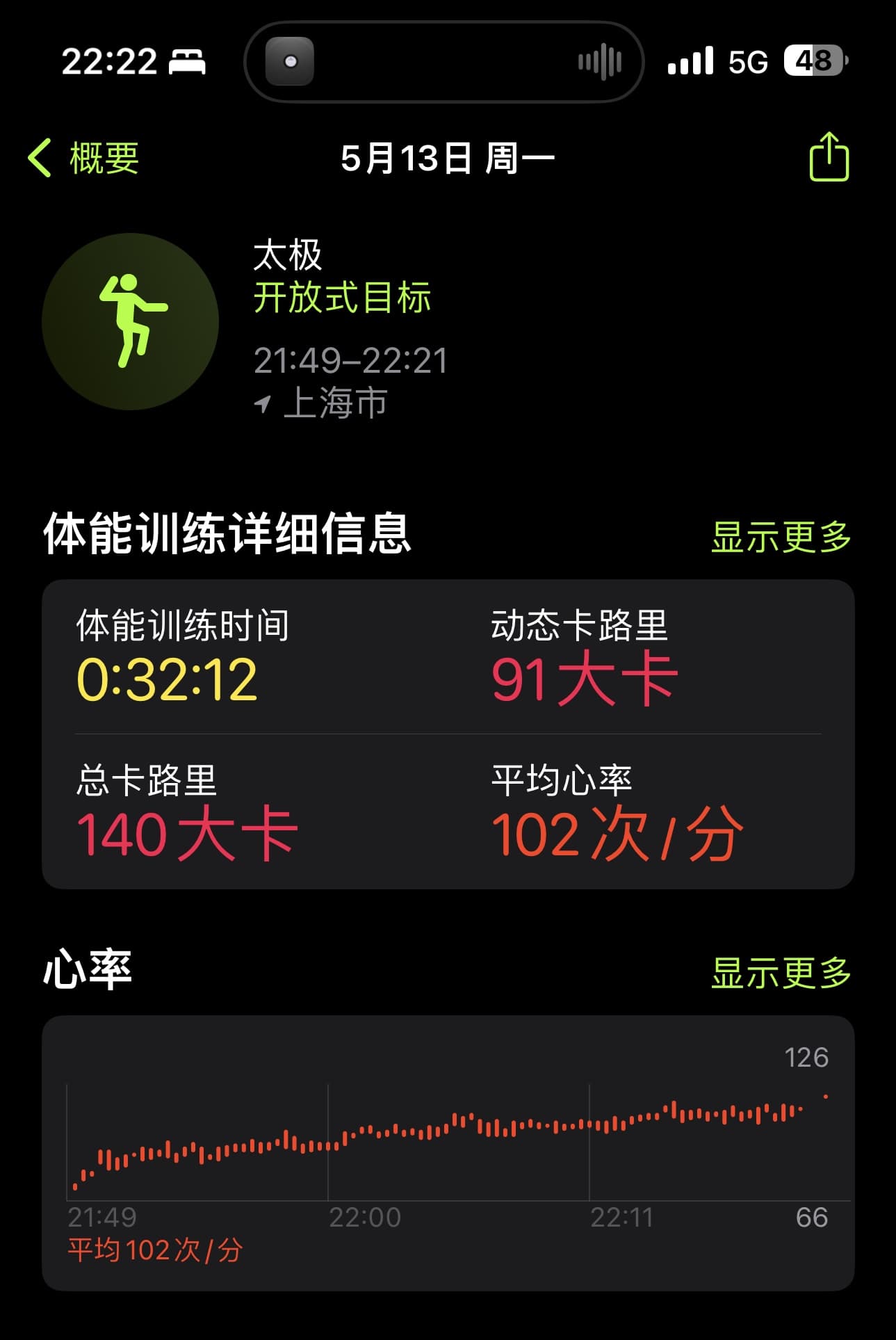
The appearance and disappearance of a sense of blockage in the chest. When I first began consistently standing, there was actually no feeling in the chest. Later, after standing for a period of time, Professor found that a clear sense of blockage began to appear in the chest, as if something in the chest became delayed between breaths. When this feeling first appeared, Professor was almost scared enough to wet himself, thinking: could this be insufficient coronary blood supply? If something went wrong by accident, that would be rather bad! After standing, heart rate and blood pressure were normal, so I did not continue worrying. Later, I slowly found that the sense of blockage disappeared, while heart rate and blood pressure did not change much compared with before. It was truly somewhat strange.
Gastrointestinal function seems a little better than before, but also seems more sensitive. Professor’s digestive function has never been very good, so changes in gastrointestinal function after standing practice are quite noticeable. It just also seems to have become more sensitive; it is truly not compatible with pre-prepared dishes at all. Whenever I eat them, I inevitably feel unwell.
There are more farts. The increase in farting has two scenarios. One is during standing practice: for a period, I would be standing and suddenly burst out a series of chained farts, which was really something. The other is while sitting normally in daily life, when a fart suddenly pops out as well. However, after 2 consecutive months of standing practice, both situations have become less and less frequent. This phenomenon also seems to indicate that standing practice enhances gastrointestinal peristalsis. It appears that standing practice is indeed a movement from the inside out!
The Benefits and Shortcomings of Hunyuan Zhuang
According to Shang Ji in Xingyi Boxing Combat Arts, the benefits of standing practice are mainly as follows:
During standing practice, the ten toes grip the ground, the soles are hollow and contained, the knees are lifted, the hips are embraced, and the anus is lifted, producing a good kidney-tonifying effect. This is because yongquan in the sole is an acupoint of the kidney meridian; the waist is the residence of the kidneys; the heel is the key of the kidneys; and the knees and shins all belong to the kidneys. The kidneys are the congenital foundation; when the kidney channel is open, kidney essence is sufficient and kidney qi is vigorous, so the body is naturally strong. From the posture of standing practice, the lower limbs bear more weight than in ordinary standing. Especially with embracing the hips, circulation and metabolism in the pelvic cavity and the bones and soft tissues of the lower limbs can be strengthened, blood flow increased, and the body’s neurohumoral regulatory system maintained in dynamic balance. The two arms are raised, which helps the intercostal muscles and diaphragm contract simultaneously; when inhaling, the thorax expands and the abdomen protrudes, greatly increasing pulmonary ventilation, while the permeability of the alveolar wall also increases. All of the above play an active role in promoting recovery. Medical practice has proved that many patients with kidney deficiency, seminal emission, lumbar soreness and weakness, neurasthenia, and stubborn insomnia have achieved satisfactory therapeutic results through standing-practice exercise.
As a form of exercise for strengthening the body, hunyuan zhuang has advantages, and inevitably also has shortcomings.
Professor has practiced hunyuan zhuang for only a short time and has not had the chance to visit seniors and ask for instruction, so his feelings are not yet deep. But from the materials I have browsed so far, I have learned of two shortcomings.
First, standing for a long time in standing practice harms the bones. This view comes from Daoist priest Zhang Zhishun. Professor thinks it has some truth, but with a premise. Standing practice emphasizes looseness and stillness, using the skeleton to support the whole body’s weight. If the method is not correct, it is indeed possible to injure the bones, especially things like articular cartilage. But there is a premise here: this may happen only when one does standing practice without practicing qi, that is, without mastering the key to breathing methods.
Second, after standing practice reaches a certain level, it is easy to develop “yang hyperactivity.” The manifestation of yang hyperactivity is fearing heat but not cold. To show yang hyperactivity, one must already have achieved something in qi practice; in other words, one’s breathing-method skill has already reached a small degree of accomplishment. Xiangyu introduced earlier had signs of yang hyperactivity. Whether judging from his habit of often wearing only a thin overcoat in winter, or from the living habits revealed by Ms. Deng, Mr. Zhou very likely had a certain degree of “yang hyperactivity.” If his practice of martial arts had not been neglected because of government affairs, he might well have become a grandmaster of his generation.
Summary
I truly never expected that writing this one piece at such length would again almost reach ten thousand Chinese characters. It is really somewhat exaggerated. Perhaps this is also one of the reasons why my writing speed has slowed so much this year: writing one article is truly too exhausting. Thinking that this series has at least 2–3 more pieces to write makes me collapse a little.
Returning to standing practice, Professor actually does not think standing practice is particularly magical. It is only a form of exercise for strengthening the body, while also allowing one to practice internal power within internal martial arts and possessing potential for fighting and combat technique. The article says very little about combat, and some methods for practicing internal power are also not covered. Another day, if Professor achieves something in his studies, he will add more.
References
- Shang Ji · Xingyi Boxing Combat Arts
- Shen Huazhang · Xingyi Boxing Course
- Liu Dianchen · A Subtle Selection of Xingyi Boxing Arts
- Li Wenbin and Shang Zhirong · A Subtle Selection of Shang-Style Xingyi Boxing and Weapons
- Ma Linzhang · Xinyi Boxing; The True Meaning of Xinyi Boxing
- Yao Chengguang · Yiquan Training Methods
- Song Guanghua · Song-Style Xingyi Boxing
- Nan Huai-Chin · Quiet Sitting, Cultivating the Dao, and Longevity
- Xue Dian · Lectures on Xingyi Boxing Arts
- Shan Changwen · Qi-Family Tongbei Boxing
- Zhu Tiances · Xingyi Boxing Martial-Arts Course