Health
Quitting Smoking, Standing Practice, and More: (I) Quitting Smoking
Over the past half year, I have basically stopped smoking, which can count as an initial success in quitting. I also began consistently practicing the foundational standing practice of internal Xingyi boxing and have gained a few small insights, so I wanted to record them for future reference when my boxing improves. While writing, I found there was far too much content, so I will split it into separate articles.
On this page
I did not expect the first article of 2024 to be delayed until now before I finally began writing it. In the blink of an eye, it is already the end of May (month 5). Thinking that this year is almost half over, I would truly feel ashamed if I did not update again. And so, this article came into being.
What I originally wanted to write was quite broad and mixed, covering all sorts of topics. Then I thought about it and, for readers’ convenience, simply decided to introduce them under different themes. That is why this first piece is about quitting smoking.
Over the past half year, Professor has been somewhat dispirited emotionally and indeed could not summon much energy to write. By contrast, there have been some changes in life habits. I quit smoking and began practicing standing practice every day. My interest in internal martial arts also rose to an unprecedented level, and I finally seem able to practice them seriously.
Returning to the matter of quitting smoking, I believe many old smokers have probably tried it before.
One does hear some success stories, but when it comes to oneself, it always feels beset with a thousand difficulties. Professor will use today’s writing as a chance to look back on his experience over the years of smoking, quitting, relapsing, and finally quitting for good. I hope it can offer inspiration and help to readers with the same trouble.
Looking Back on My Smoking History
Professor’s smoking history probably goes back to a breezy evening in May (month 5) of 2006, when a light wind was blowing.
At that time, Professor was already in year 2 of medical school and had gradually become familiar with the heaviness and complexity of medical courses. Besides anatomy, which was highly practical, he also had to learn physiology, pathology, molecular biology, and other foundational medical courses. The difficulty of each course was often directly proportional to the thickness of the textbook. Many subjects started from zero, and some courses used purely English textbooks. The learning curve was steep indeed, so much so that even thinking back on it now still feels thrilling. I vaguely remember buying a molecular-biology vocabulary book from a bookstore back then and memorizing it fiercely whenever I had spare time. It was rather fulfilling.
The tight rhythm of classes day and night, combined with challenging academic pressure, plus the magical feng shui treasure land of the ancient capital where the school was located that caused Professor to suffer insomnia until 3 a.m. every night, inevitably left a gloomy feeling wandering in his heart.
So on that evening in May (month 5), I went to the small shop beside the cafeteria, bought a pack of cigarettes and a lighter, walked into the sports field, sat alone on the steps of the stands, quietly lit a cigarette, and silently told myself: “Bro, you have to learn how to smoke!”
The first experience of smoking is usually not very good. After lighting that first cigarette, I smoked while choking and coughing, and my heart shook violently: “What the hell is this? Where is the pleasure? Nonsense!”
I had thought that after this ordinary evening, my curiosity about smoking would fade away. Unfortunately, after that experience, some switch seemed to have been flipped, and I slowly picked up the bad habit of smoking.
Perhaps it really was because the academic pressure was too great. After I began smoking, the frequency and amount quickly reached 1 pack (20 cigarettes) per day. Over all these years, except during a few intermittent periods of quitting, it remained at this frequency until I quit smoking in January (month 1) of this year. Thinking about it now is quite frightening. After all, when studying medicine, I knew that once the smoking index exceeds 400 cigarette-years (cigarettes per day × years), the risk of certain diseases increases greatly.
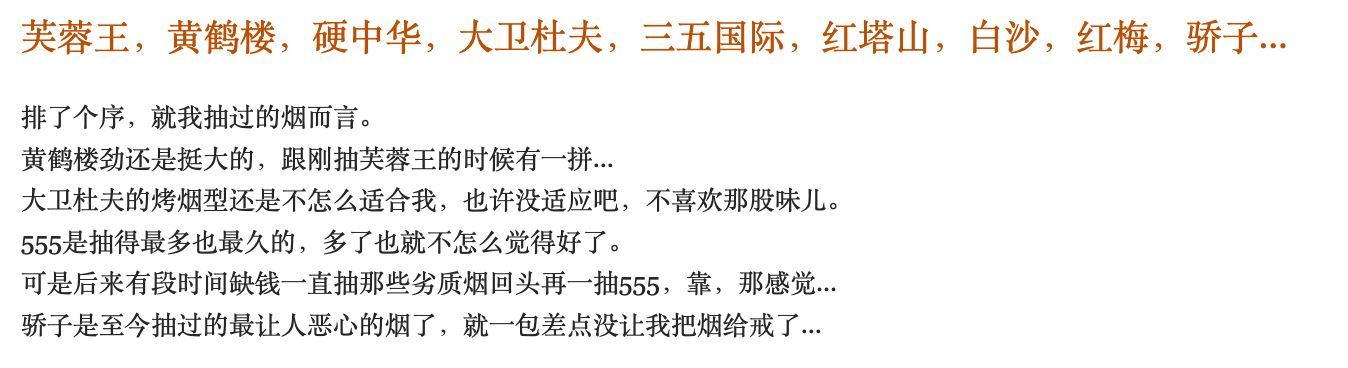
Different tobacco products taste quite different, but in the end they all merely give the brain a moment of dizzy haze through nicotine. Of the cigarettes Professor has smoked, the best-tasting were first the Shanghai-made Panda cigarettes (tobacco shops generally sell them at a markup, so the value for money is not great), followed by certain specific batches of soft-pack Zhonghua (the Zhonghua usually sold in convenience stores tastes extremely bad). The one I smoked most was Su Yan, from university all the way until before I quit, which counts as my most long-term choice. Of course, in student days the cigarettes I smoked were much more varied; the main principle was to scrape together a pack when I had no money. Looking back at early blog posts, I found that my old self was a complete goofball:
 Open larger image: image.png
When reviewing this history, Professor also kept reflecting: why would a poor university student, even in economically difficult circumstances, still persist in such a bad habit as smoking?
It was only when I read Poor Economics that I saw one observed phenomenon: when poor people have more money, their choices often tend toward making life a little less dull, rather than making the most rational decision to buy more staple food to ensure the calories needed each day. In essence, this is still only a surface phenomenon. After all, when someone is trapped in the present circumstances and cannot change reality with their existing horizon, pattern of thinking, and rational decision-making ability, it is actually quite reasonable for them to make a choice that bystanders see as neither “rational” nor “appropriate.” This probably explains why, during university, I did not add a chicken drumstick to every meal, but insisted on buying a pack of cigarettes instead. Studying medicine was truly too bitter!
However, once that person resolves to break through the barriers—for example, resolves to quit smoking—then every turning point follows.
Back to the topic of quitting smoking. In so many years of smoking, the experiences I can truly remember of gaining pleasure from smoking are actually few and far between. More often, smoking seemed to become a way to pass loneliness, or a means of socializing. This feeling is rapidly amplified during attempts to quit smoking, and it is also why many people find it so hard to quit successfully.
Strong psychological dependence and an easily accessible smoking environment are challenges every person quitting smoking has to face.
Frankly speaking, although smoking is not behavior worth advocating, it is indeed an effective social tool. Especially in a city like Shanghai, where indoor smoking is banned, going downstairs to smoke makes it easy to meet fellow smokers from one’s own company or other companies in the same building. During chats and exchanges, it is quite easy to obtain new information or knowledge. This means that when a person who wants to quit smoking truly begins to try, he needs to actively reshape the smoking environment around himself, including the social environment.
Of course, apart from the so-called social advantages, smoking has almost nothing but disadvantages.
In any case, smoking is a bad habit. It harms not only oneself, but also others indirectly. Especially under China’s relatively open smoking-control policies, secondhand smoke can be smelled almost everywhere. After Professor quit smoking, he became very sensitive to the smell of smoke and was surprised to find that almost every time he exited the subway, walked along the street, or waited at an intersection for the traffic light, he could smell a faint tobacco odor. Even after quitting smoking, one may still be unable to escape tobacco’s harm. This requires the joint effort of society as a whole.
Experiences of Quitting Smoking
Before officially quitting, Professor had actually had several experiences of quitting smoking, but unfortunately all failed.
As a smoker with a medical background, Professor had long been aware of tobacco’s harms and did have some willingness to quit. At first, I would occasionally try going a day without smoking, but it would not be long before my heart began to itch unbearably, and I could not help lighting another cigarette. Later, I gradually came to understand what kind of wretch I was and wondered whether I could smoke a few fewer cigarettes each day, so at least the total daily amount would go down. You should know that in our era, there was still a rumor going around that smoking one cigarette would shorten life by about 6 minutes. If the total amount could be reduced, it should also help health.
Although I now know this idea is one of the misconceptions about quitting smoking, I did try it for a while back then. Ridiculously, it was not long before I relapsed into old habits, and it even had the consequence of my smoking more and more.
There were probably 2 truly formal attempts to quit smoking, in 2019 and 2022 respectively. The methods were very different; only the ending was the same: neither succeeded.
The 2019 attempt mainly relied on personal willpower, combined with medication: smoking-cessation drugs prescribed by a hospital. That year, Company B happened to have a quit-smoking campaign, so I signed up along the way, with great expectations of successfully quitting.
This quitting attempt was very serious and lasted more than 3 months from start to finish. During those 3 months, I did not smoke a single cigarette and held on entirely by willpower. During this period, I also called the campaign’s smoking-cessation hotline 2 times, and each conversation lasted 1 hour. The counselor on the other end of the line gave many practical suggestions, such as throwing away all items related to smoking, as well as some psychological-preparation techniques. During this process, I also finished taking the smoking-cessation medicine.
Although I forced myself to persist for 3 months through willpower, my mental state was extremely uncomfortable. It was like a tug-of-war: I was constantly competing with another invisible version of myself. More frighteningly, during the quitting period, my mood was extremely irritable and easily angered, as if my entire body were covered with powder kegs that would explode at the slightest spark. I was completely like a little tyrant ready to fight heaven, earth, and the air.
After suffering through 3 months of psychological dependence and the torment of explosive emotions, Professor finally decided to give up quitting smoking. I felt that if things continued this way, I would soon lose my job. After all, at that time the way Line looked at me had already become a bit off…
At the end of November (month 11) in 2022, as everyone knows, domestic controls were suddenly and completely lifted, followed by the experience of catching COVID for the first time. Professor was infected in early December (month 12) and gradually recovered in late December (month 12), going through about 3 weeks of life-and-death torment. During this time, except for smoking when the symptoms were still not obvious on day 1, I never touched cigarettes again afterward.
After a serious illness, people’s understanding of life often becomes a little more transparent. Hmm, I never wanted to smoke again.
This quitting attempt lasted about 2 months and ended when I celebrated New Year in Xiamen in 2023, during that trip. Xiamen seems not to favor me; I should avoid it in the future.
Fortunately, from January 21 (month 1) this year until now, I can count as having quit smoking completely.
Why did it succeed this time? Because heaven once again gave a sign: if I did not quit, I felt I was going to be done for… 😂😂😂
Why Quitting Smoking Is So Hard
Based on Professor’s own quitting experience, the difficulty of quitting smoking comes down to 3 dimensions of influence: nicotine withdrawal reactions at the physical level, psychological dependence at the mental level, and an external environment unfriendly to quitting. Of course, these are only Professor’s personal experiences. Everyone’s actual circumstances differ, and the challenges they face will naturally differ as well.
First, let us talk about nicotine withdrawal reactions during quitting.
To understand nicotine withdrawal, one first needs to understand how nicotine acts in the body. For readers’ convenience, Professor will simplify the relevant pharmacological knowledge as much as possible. If professional readers see this, please do not mind.
Nicotine is also called tobacco alkaloid. The “smoke nicotine amount” generally marked on the side of a cigarette pack refers to the concentration of this substance produced during the burning of each cigarette. When old smokers judge whether a cigarette tastes “light” or “heavy,” they are usually referring to the effect brought by this indicator.
Nicotine is an acetylcholine-receptor agonist. It can specifically bind to acetylcholine receptors in the body, thereby acting on the human sympathetic/parasympathetic nervous systems and the central nervous system. Compared with a relatively “proper” neurotransmitter like acetylcholine, nicotine has a higher “intimacy” with the receptors: not only does it bind more tightly, it also binds for longer, so the neural signals sent after binding are somewhat stronger.
So, what signals does nicotine send?
After nicotine is absorbed through pulmonary circulation into the blood, it can pass through the blood-brain barrier and reach the brain in about 7 seconds, acting directly on relevant functional areas and stimulating the production of “dopamine,” thereby creating feelings of pleasure and comfort. In addition, nicotine also stimulates the sympathetic/parasympathetic nervous systems, prompting the body to release adrenaline and norepinephrine, causing a series of effects such as faster heartbeat, faster breathing, and higher blood pressure. Put plainly, it is like “getting a shot of chicken blood and enjoying a quick thrill.”
For a long-term smoker, nicotine’s frequent “shot of chicken blood and quick thrill” effect also stimulates the brain to form its own unique “reward mechanism,” which is the so-called “addictive” effect.
When we start trying to quit smoking, there is no way to give ourselves that “shot of chicken blood,” nor can we “enjoy the thrill.” At the same time, the brain cannot establish an effective “compensatory” “reward mechanism,” so naturally quitting smoking becomes very hard and painful.
So you see, at the physical level, if you want to overcome the influence of “nicotine withdrawal reactions,” the best way is to establish a healthier “reward mechanism,” such as exercise. Of course, using medication for nicotine-replacement therapy is also one option.
Second, psychological dependence is even stronger than nicotine addiction.
Purely from personal experience, Professor believes that the influence of “psychological dependence” during quitting is greater than that of “nicotine withdrawal reactions.” In the previous 2 failed quitting experiences, the final defeat in every case came at the hands of “psychological dependence.”
No matter how strong your willpower and action to quit smoking may be, and even if you yourself may be a person of extremely tough and decisive character who can rely entirely on a “thought seal” to restrain yourself from smoking, the accumulated negative feedback in your emotions—irritability, anger, anxiety, worry, and even violent tendencies—may ultimately still cause your great quit-smoking plan to fail at the last step.
Therefore, when you truly resolve to quit smoking, you must make complete psychological preparations, and you must treat your commitment to quitting smoking as a truly great undertaking. Constantly give yourself positive emotional feedback, build confidence, and hold a firm belief that this undertaking of quitting smoking will succeed. At the same time, for the commitment you have made to quit smoking, you should uphold it consistently every morning, every afternoon, every dusk, and at every moment of every day.
Seeking support from friends and family, or guidance from professionals, are all very effective auxiliary methods. But in the end, all external factors still depend on your firm belief in quitting smoking, or what might be called “sudden enlightenment.” When you truly understand the real meaning of quitting smoking, you will surely be able to reach the shore of success! 💪💪💪
Finally, smoking is something far too easy to do.
It has to be said that the domestic tobacco environment is indeed somewhat too relaxed, and smoking is basically not difficult at all. Cigarettes can be bought in convenience stores that are almost everywhere.
In addition, domestic cigarette packaging is very attractive. On this point, we really should learn more from overseas examples and give smokers more warnings on the packaging. Doing so would indeed have some effect. Imagine that when you see cigarettes in a duty-free shop, every pack is printed with blackened lung-anatomy images. Even if you wanted to smoke at the time, after seeing such an unlucky-looking image, you would probably not have much appetite for it.
Another unfriendly external environment for quitting is that many domestic social interactions are inseparable from cigarettes.
When we resolve to quit smoking, besides clearing away any smoking-related items from every aspect of our work and living environments, we also need to complete “social isolation” within our own social circles.
The so-called “social isolation” here does not mean giving up social interaction entirely, but actively refusing “tobacco socializing.” This is also related to the commitment to quitting smoking mentioned above. A person quitting smoking should always maintain his commitment to himself and shoulder the responsibility of saying no to “tobacco socializing.”
Of course, Professor has recently been pleasantly surprised to find that the external environment for quitting smoking has gradually begun to improve.
On May 25 (month 5), Shanghai officially released the Requirements for the Setting and Management of Outdoor Smoking Areas, which will come into effect on September 1 (month 9) this year. This is China’s first standard specification for outdoor smoking areas.
Shanghai has once again taken the lead in the country, and the Shanghai municipal government deserves everyone’s praise. 👍👍👍
Ways to Quit Smoking
Professor recommends several methods for quitting smoking, hoping they can help more old smokers walk out of the haze of quitting and gain a healthier lifestyle.
1. The Easy Way to Stop Smoking
Very effective
When talking about quitting smoking, one must mention the book The Easy Way to Stop Smoking. The author is an old British smoker named Allen Carr.
The main reason I recommend this book is that the author provides many extremely valuable concepts in it. Reading the whole book can help you quickly understand the preparations for quitting smoking and some common misconceptions.
The point that influenced Professor personally the most is that the method of “quitting by cutting down” is not advisable, which matches my own experience. In addition, a large portion of this book is actually teaching old smokers how to prepare psychologically in order to deal with potential challenges during quitting. This is exactly what Professor mentioned earlier: the hardest part of quitting smoking.
Therefore, I would recommend that every old smoker determined to formally quit should quickly finish reading this book.
2. Counseling
Effective
The effectiveness of counseling for people quitting smoking varies from person to person. The main reason is that many counselors engaged in smoking-cessation counseling do not smoke themselves. Their experience and knowledge largely remain at the theoretical stage.
Of course, the good side is that counselors have a very strong capacity for empathy. When you encounter difficulties during quitting, cannot hold on and want to give up, or feel emotionally depressed and unable to find relief, the help and support provided by a counselor can let you pass through this difficult period more peacefully.
3. Smoking-Cessation Medication
Effective
From Professor’s previous quitting experience, smoking-cessation medication still mostly stays within the scope of nicotine-replacement therapy. If you are more inclined to use exercise to resist physical withdrawal reactions, drug treatment is not necessarily required.
Smoking-cessation medication cannot guarantee that you will definitely quit successfully, nor does it mean that after a hospital prescribes smoking-cessation medication, there will no longer be psychological dependence on tobacco. This point needs to be clearly understood.
In addition, please note that some side effects of smoking-cessation medication may also aggravate emotional symptoms during quitting. Be sure to use it under the guidance of professional medical personnel at a professional medical institution.
4. Exercise
Very effective
Exercise, especially aerobic exercise, is highly recommended as one compensatory way for us to deal with “withdrawal reactions.”
When quitting smoking, our exercise plan should be reasonable, match our current physical condition, and proceed within our ability. Compared with burning a huge number of calories in a single workout, Professor more strongly encourages you to establish an appropriate exercise plan that you can persist in over the long term. When you begin exercising regularly over a long period, your whole body is mobilized, and your personal emotions can also become more positive. This is the charm of exercise.
The exercise Professor chose is Xingyi boxing among the internal martial arts, and at present he mainly practices standing practice among the fundamentals. This was also the second theme this article originally wanted to share. Unfortunately, the quitting-smoking section became too long, so I will introduce it in detail to readers later.
5. Quoy
Very effective
Quoy is a smoking-cessation app. At first, Professor was very resistant to this type of quit-smoking app. I thought, if using such an app, would it not be equivalent to having a program regularly remind you every day that it is now time to smoke?
After encountering the Quoy app, Professor’s view completely changed. The developer of this app is absolutely also a quit-smoker who has endured many hardships.
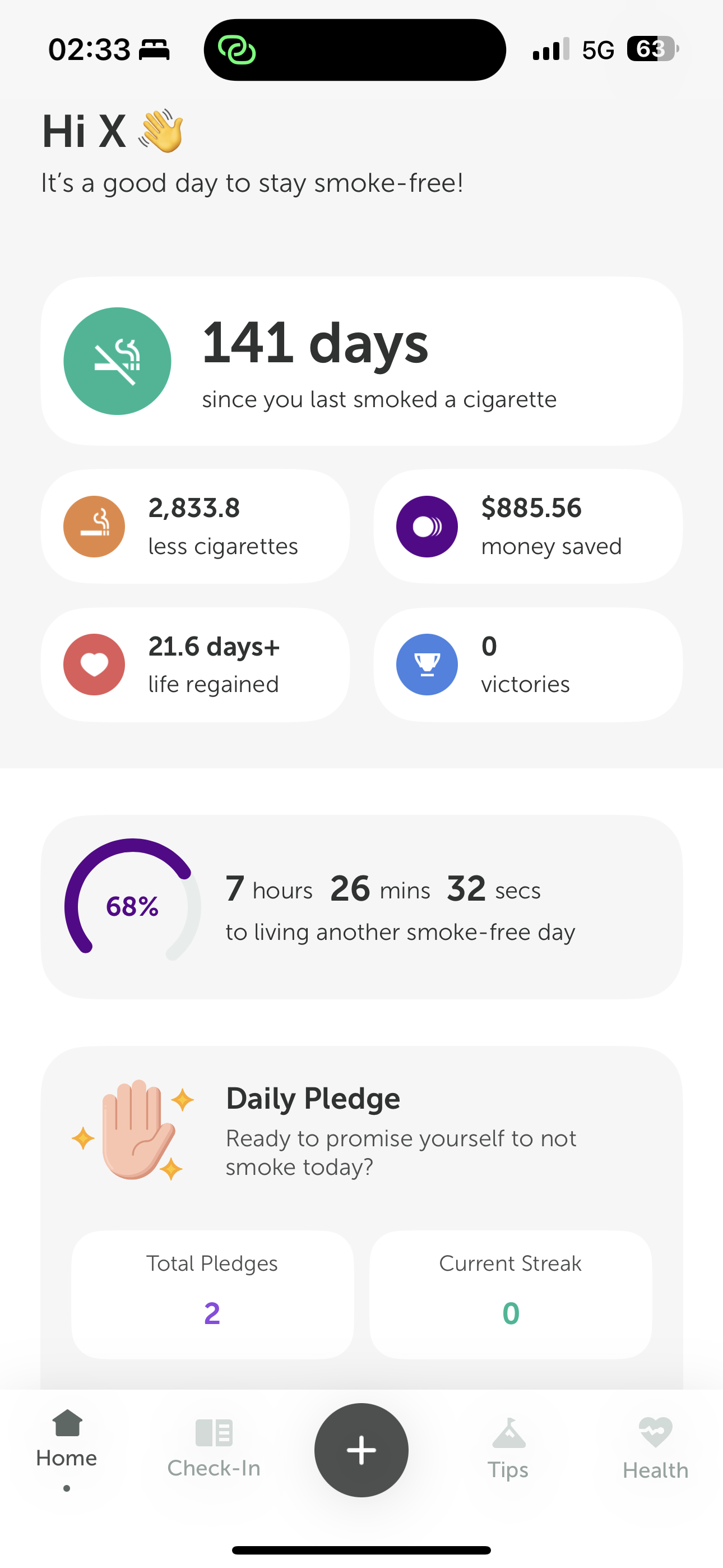
This app can help people quitting smoking enter the right state very quickly, deeply understand the value of quitting, and regularly fulfill their commitment to their quit-smoking goal. During use, it continuously makes quitters realize that they are making progress, and it keeps strengthening self-identity and confidence in quitting.
 Open larger image: IMG_3706.png
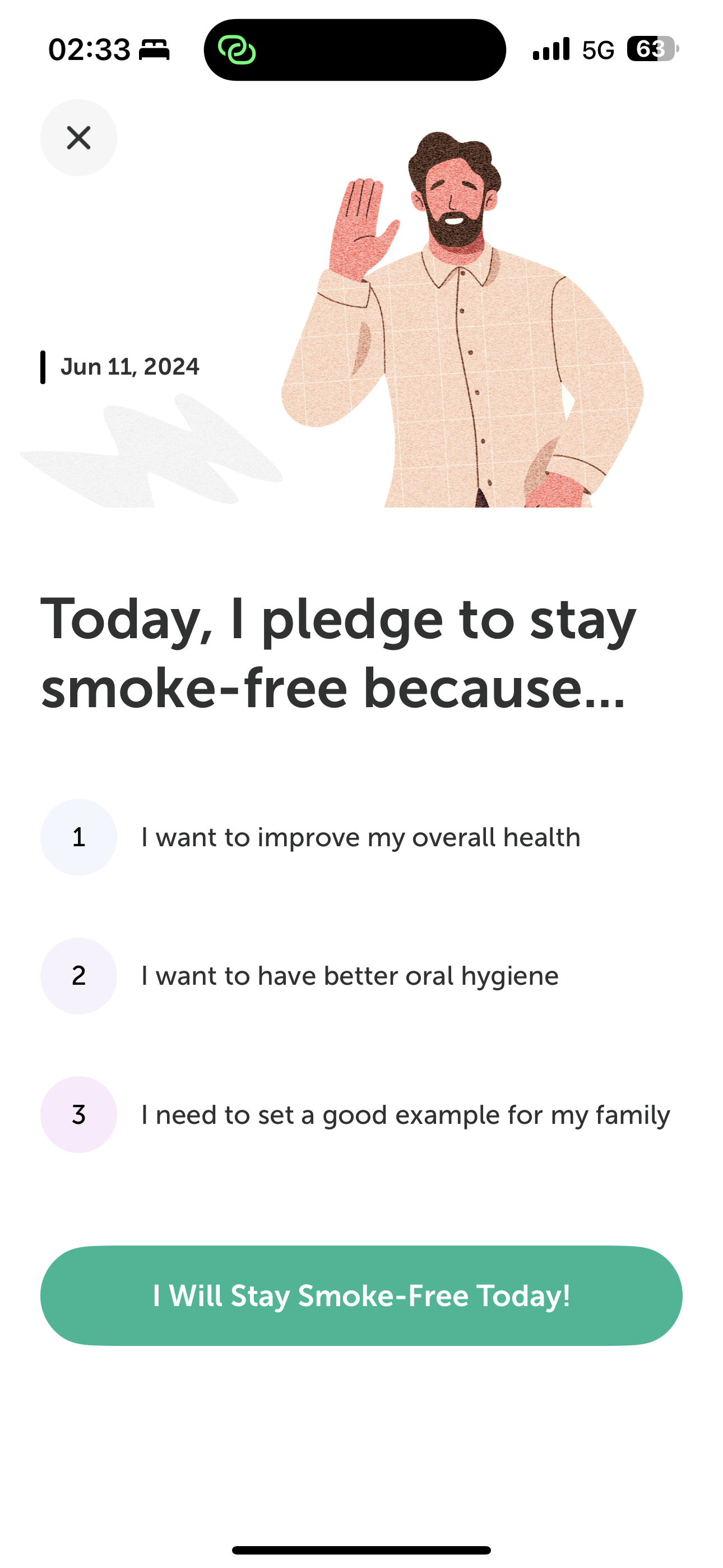
Daily Pledge is the function Professor appreciates most. Although Professor no longer needs to check in every day, for smokers quitting for the first time, it can help everyone quickly develop the habit and strengthen their belief in quitting.
 Open larger image: IMG_3707.png
6. Firm Belief
Very effective
You are far stronger than you imagine. Once you establish a firm belief in quitting smoking, you will certainly be able to overcome all the difficulties encountered in the process! Please be sure to give yourself confidence and hold fast to your commitment to quitting smoking.
Among the 6 methods above, firm belief is the most difficult, but it is also the most effective. Once you have thought clearly about why you want to quit smoking, firm belief will not only accompany you during the period of quitting; it will become the main thread running through the rest of your life. Once you succeed in quitting smoking, I believe you will likewise be invincible and unconquerable in any future undertaking!
Summary
Quitting smoking is not easy. Through the experience shared in this article, Professor hopes that every smoker attempting to quit will succeed. Leslie Cheung once had a quit-smoking-themed song, No Smoke, Only Flowers, with excellent lyrics: “In childhood there was no it; memories were like paintings, and every day I breathed in and breathed out without relying on it.”
I wish all of you success in quitting smoking!
References
- https://zh.wikipedia.org/wiki/%E5%B0%BC%E5%8F%A4%E4%B8%81
- https://mp.weixin.qq.com/s/dpc31Diz5QRfCQzqPpIhKQ
- https://apps.apple.com/us/app/stop-smoking-tracker-quoy/id6444828976
- https://www.youtube.com/watch?v=YKx5Q_kOMwE