Culture
Some Thoughts on Diversity, Inclusion, and Equity
Every September is the company’s Global Diversity and Inclusion Month. Today, on the last day of September, Professor talks with everyone about some thoughts on diversity, inclusion, and equity. These are humble personal views, without any tendentious stance, and I hope they will give readers some inspiration.
On this page
Background
Every September is the company’s Global Diversity and Inclusion Month, a tradition that has continued for more than ten years. Every time this month comes around, the company holds a series of activities and online and offline Workshops to spread the idea of diversity and inclusion. From the global CEO to the China CEO level, this activity is treated with great importance, with the aim of promoting the organization’s values of diversity, equity, and inclusion at the company level so as to better serve our customers and patients.
Today, on the last day of month 9, Professor would like to talk with everyone about some thoughts on diversity, inclusion, and equity. These are humble personal views, without any tendentious stance. If you have your own views and position, Professor respects that.
What Is Diversity and Inclusion ( DE&I )
Diversity and inclusion ( DE&I ) mainly contains the three dimensions of diversity ( Diversity ), equity ( Equity ), and inclusion ( Inclusion ), and is part of the corporate values upheld by more and more organizations. Usually, these organizations are committed to supporting different individual groups, including but not limited to people of different races, religions, abilities, genders, and sexual orientations.
From an organizational perspective, building a diversity and inclusion ( DE&I ) corporate culture is not easy, especially in the current “de-globalization” landscape full of VUCA (Volatility, Uncertainty, Complexity, Ambiguity) challenges. Under the great banner of Western democratic freedom and equal-rights thinking, companies’ earlier efforts in diversity and inclusion have therefore become increasingly important. Fortunately, the company where Professor currently works has long attached considerable importance to this in its corporate culture, so it is also easier to glimpse some differences in the practice of diversity and inclusion under different Chinese and Western cultural backgrounds.
Promoting the three elements of diversity and inclusion at the organizational level often requires different strategies.
For promoting organizational diversity, what the company most needs to influence is every person in the organization and their ideas, making the greatest possible effort to let employees know and understand the value of diversity, practice it in daily work, and make their own efforts and contributions in the process.
For promoting organizational equity, frankly, this is the most difficult of the three dimensions. Professor will explain the reasons for the difficulty in detail below. Promoting organizational equity at the company level needs a series of efforts in internal policies, practice guidance, and organizational design as support; this also means that corporate leaders need to view the matter from a strategic perspective. How to ensure that, under the principle of organizational equity, the company can retain vitality and agility and achieve its established business goals is in fact a great test of leadership.
Finally, in promoting an inclusive organizational culture, the focus is on building an inclusive corporate culture and encouraging employees to speak up bravely and contribute their own strength.
We have talked a lot above about company-level efforts, but the most important component in realizing diversity and inclusion ( DE&I ) is actually still every person in the organization. Whether a Leadership Team Member, a functional department, or a support department, only the active participation and contributions of every employee can ultimately help us build a relatively complete diversity and inclusion corporate culture. Very often, as employees, we need to make enormous efforts to change existing ideas and abandon possible unconscious biases.
Believe me, this is not easy to do. It requires us to be clearly aware of what actions we can take, how to make changes, and how to shift our mindset, thereby driving changes in practical behavior. If everyone longs to be seen, heard, valued, and respected, then we should participate with an open mindset; even if it is very difficult, we should show empathy while seeking to understand others’ views.
Diversity ( Diversity )
Diversity refers to the variety of similarities and differences among people, usually called dimensions of diversity, including but not limited to: sex, gender identity and expression, ethnicity, race, native or indigenous identity/origin, age, generation, disability, sexual orientation, culture, religion, belief system, marital status, parental status, pregnancy, socioeconomic status/caste, appearance, language and accent, mental health, education, geography, nationality, work style, work experience, work role and function, thinking style, and personality type. The representation of the various dimensions of diversity within an organization may vary by geography, time, or organization.
For traditional Eastern culture, because the influence of Confucian ideas is too profound, ordinary people’s ideas often easily fall into a situation similar to a “binary paradox.” The most typical example is that a certain Mr. Li of a certain Baidu once said that “Chinese people are willing to trade privacy for convenience.” It seems as if Chinese people can forever choose only one of privacy and convenience, and that there is no beautiful future in which groups who value privacy and groups who value convenience can exist under the same time and space.
However, even the “binary paradox” in economics (the free flow of capital and the independence of monetary policy cannot both be had) eventually derived the theory of the “trilemma” (among the free flow of capital, exchange-rate stability, and the independence of monetary policy, at most two can be chosen). As ordinary people, we might as well view this world with a more open mindset. After all, human civilization is developing continuously, and our era is also continuing to progress under the push of the wave of technology.
We know that biodiversity built the beautiful planet on which we live, and the development of human civilization cannot be separated from a world of biodiversity. Whether it is the food, medicine, energy, and chemical raw materials necessary for our survival, or the climate environment built by ecosystems, all are closely related to the planet’s biodiversity. By the same logic, at the organizational level, or more broadly, at the national level, for employees, for citizens, and for thousands upon thousands of ordinary members of the public, diversity exists universally. For the public, accepting diversity among groups of people is accepting ourselves.
When embracing diversity, the challenge lies in overcoming unconscious bias, especially those stale rumors and gossip. In this process, themes related to equity and inclusion are often also involved, and the three are often connected with and influence one another.
To give a simple example, I believe everyone, in their past lives, has more or less been subtly instilled with some fixed impressions about people from different regions. For example, Northeasterners are said to have relatively bold and forthright personalities, Shanghainese are said to be relatively exclusionary, and Hubei people are said to be relatively crafty—isn’t there the saying, “nine-headed birds in the sky, Hubei fellows on the ground”? The unconscious biases created by these fixed ideas often cause us, when getting along with different types of people, to unconsciously develop guarded or discriminatory feelings, thereby affecting production and life practice. This is the resonance that arises between the ideas of diversity and inclusion.
Of course, embracing diversity does not mean that one must unconditionally accept everything wholesale. As adults with the ability to judge, we should rationally evaluate and respond to scenarios that may be more complex according to the actual situation. What is rather harsh about reality is that the complexity of the world often exceeds our imagination. If what we face is a situation similar to a threat to life or the causing of major loss, caution and avoidance do not conflict with our idea of supporting diversity.
In addition, embracing diversity is also closely related to equity. For example, in a company’s recruitment process, if it blindly pursues the principle of diversity first, it may head down the road of extreme political correctness and thereby harm equity.
So you see, is embracing diversity not very challenging? We are always in a process of constant evolution, striving to shape ourselves and our organizations into something better.
Equity ( Equity )
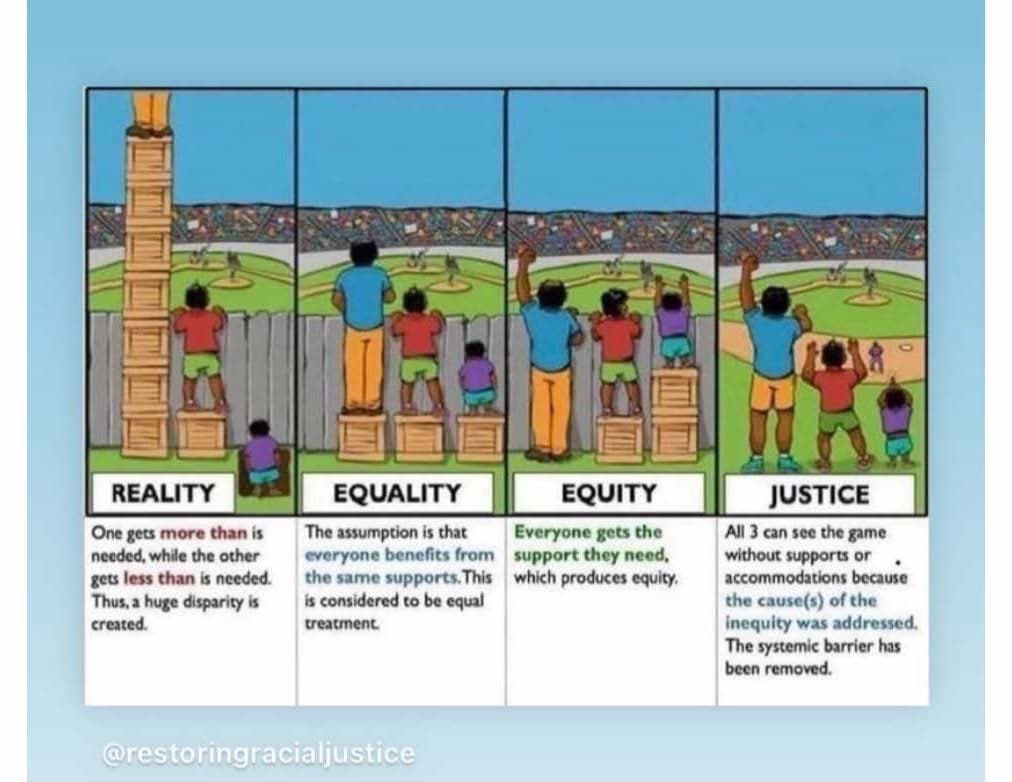
Equity is about fairness and justice. It is about how to promote fairness in opportunity and well-being by taking careful and well-considered action to eliminate systemic, group, and individual barriers. Equity is achieved by identifying and eliminating the policies, practices, attitudes, and cultural messages that lead to and reinforce unfair outcomes. The distinction between equality ( Equality ) and equity ( Equity ) must be emphasized. Although both promote fairness, equality achieves it by treating everyone equally, regardless of needs and circumstances. Equity achieves this by treating people in different ways, depending on needs, circumstances, and consideration of historical and systemic inequalities.
Very often, people tend to confuse the concepts of equality and equity. Even for the same idea about DE&I, the United Kingdom calls it EDI ( Equality, Diversity and Inclusion ). You see, Great Britain merely emphasizes equality. As for the difference between equality and equity, when Professor was reading Boston University’s Toolkit on DE&I, he found an illustration from @restoringracialjustice that explains the difference between the two very well:
 Open larger image: Equity.jpg
From this picture, it is very intuitive to understand that the effort required to achieve equity ( Equity ) is far more complex than equality ( Equality ). This is also why Professor said earlier that promoting organizational equity is much more difficult than the other two.
At the same time, if we combine this picture and then look back at the recent anti-corruption storm in the pharmaceutical industry, it seems easier for us to understand the good intentions of the superstructure. In fact, the Chinese government has long been working to realize fairness and justice in the industry and to create a more positive and healthy medical market. As practitioners in the medical industry, besides recognizing the government’s actions, we should start from ourselves and practice business conduct with high ethical standards, thereby ultimately benefiting patients.
Inclusion ( Inclusion )
Inclusion is a dynamic state concerning emotional feelings, a sense of belonging, and practical behavior, in which the power of diversity needs to be valued and used to create a fair, healthy, high-performing organization. An inclusive culture and environment ensure that everyone can gain fair access to resources and opportunities. It also enables individuals and groups to feel safe, respected, heard, encouraged, motivated, and valued.
Inclusion is the last dimension we mention, but it is also the dimension that most needs individuals to practice it actively.
In the past, Professor was a rather aggressive person. In order to achieve established project goals, he was often very forceful and would invisibly bring enormous pressure to partners. This also gave him a very poor reputation in the IT department he mainly interfaced with. Back then, when their structure was adjusted and they needed to replace the project owner who interfaced with him, the IT Head specifically reminded the new owner to be careful of Professor, because “Professor is very hard to deal with.” It is no wonder the IT colleagues complained; some former ways of cooperating were indeed not very appropriate. There was even one time in an Agile Team Weekly Huddle when he almost made a girl from the neighboring team cry. Thinking back on it now, he often feels self-reproach and guilt, and constantly reminds himself that in future work and life he needs to continue working hard to practice the idea of diversity and inclusion, so that partners and team members can feel respected, heard, and valued.
Professor will also work hard to practice this idea in life.
Tips for Practicing DE&I
From team managers to individual employees, we can all contribute our own strength to building a diverse and inclusive organizational culture, and show constructive actions and results. Here are some small tips for everyone to refer to in the process of practice:
Participate in dialogue: try to understand and temporarily set aside the desire to debate. Ask your team what they need you to do now, commit to continuing open dialogue, and become a visible supporter.
Examine your mindset: what ideas or unconscious biases might you hold? What prevents you from supporting those whose views/ideas may be different from yours?
Self-education: learn about others’ life experiences and viewpoints through books, articles, films, and/or museums.
Show empathy: temporarily set aside judgment ( Judgment ), remain open, and be willing to include, listen to, and respect others’ viewpoints.
All of this requires a growth mindset—that is, one oriented toward self-improvement and willing to persevere when facing challenges and failure, because every challenge and failure is an opportunity for growth rather than a signal that our ability is insufficient.
In Closing
I believe that if you have read this far, you already understand that embracing the values of diversity and inclusion is not simple, but it is not out of reach either.
A diversity and inclusion corporate culture can bring employees an enormous sense of belonging, and is hugely valuable for an organization. Taking Professor’s company as an example, globally, 71% of employees firmly believe they can obtain good career development at the company. At the annual meeting, the leadership also revealed that the company’s turnover rate is much lower than the industry average. Referring to the performance growth of recent years, I believe that the diversity and inclusion corporate culture and high standards of business ethics deserve great credit for healthy business growth.
May everyone have the capacity for diversity and inclusion, and be able to feel safe, respected, heard, encouraged, motivated, and valued!
References
- [1.] https://www.bu.edu/diversity/resource-toolkit/inequity-equality-equity-and-justice/
- [2.] https://www.mckinsey.com/featured-insights/mckinsey-explainers/what-is-diversity-equity-and-inclusion
- [3.] https://en.wikipedia.org/wiki/Diversity,_equity,_and_inclusion
- [4.] https://dictionary.cambridge.org/dictionary/english/edi?q=EDI